
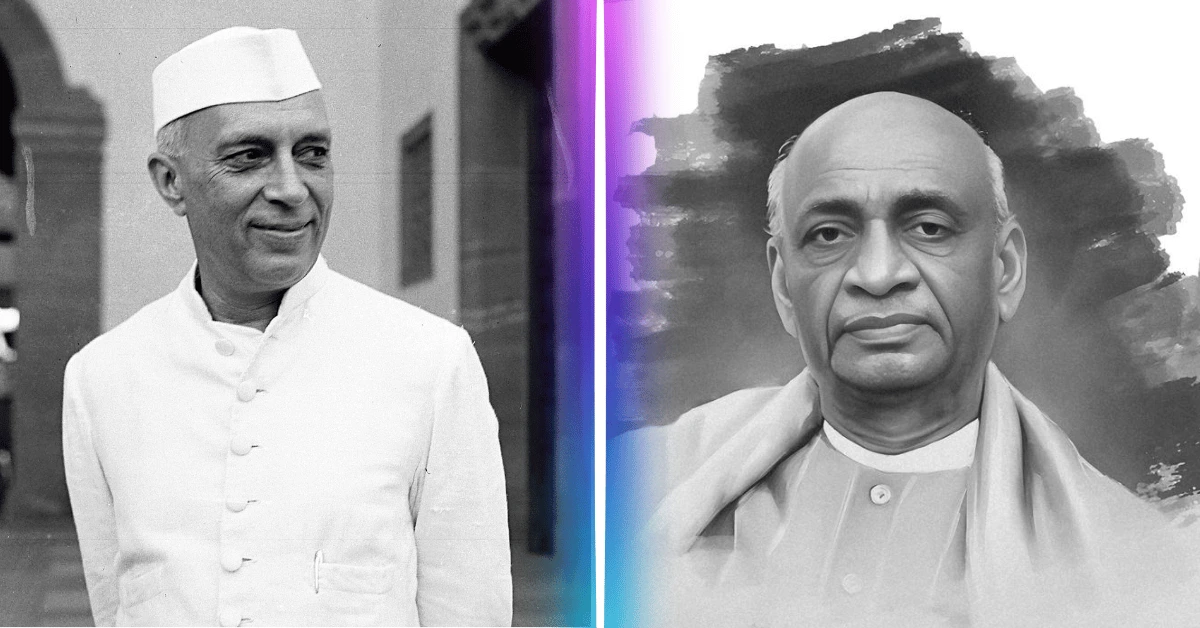

When India gained independence in 1947, the nation faced both excitement and uncertainty. Partition had caused chaos, millions were displaced, and building a functioning democracy seemed daunting.
In this moment of transition, two leaders shaped the direction of the country: Jawaharlal Nehru, India’s first Prime Minister, and Sardar Vallabhbhai Patel, the first Deputy Prime Minister and Home Minister.
Though allies in the freedom struggle, Nehru and Patel held different visions for India’s future. Their approaches continue to influence Indian politics, governance, and foreign relations even today.
Political Philosophies
The differences between Nehru and Patel were most visible in how they viewed political power.
Nehru’s Belief in Liberal Democracy
Nehru was inspired by Western liberal thought and socialist ideals. He believed India must embrace:
- Parliamentary democracy as the backbone of governance
- Secularism, ensuring religion and politics stayed separate
- Individual rights and freedoms as a foundation of the new republic
For Nehru, democracy was more than a system — it was a tool for transforming India into a just and modern society.
Patel’s Commitment to Strong Administration
Patel’s approach was more pragmatic. He focused on:
- Discipline and central authority to maintain order
- Administrative efficiency through strong institutions
- National unity before ideological reforms
Patel believed democracy required stability and control to survive in a newly independent nation.
👉Read Also: Why “Jai Hind” Became the Symbol of Indian Unity
Economic Strategies
The two leaders also diverged on how India’s economy should grow.
Nehru’s State-Led Development Model
Nehru saw industrialization as the key to modern India. His policies included:
- Establishing the Planning Commission
- Launching the Five-Year Plans
- Prioritizing heavy industries and public sector enterprises
- Investing in scientific research and education
This model laid the foundation for India’s technological and industrial base but also created an economy dominated by bureaucracy.
Patel’s Market-Friendly Pragmatism
Patel preferred a balanced economic approach. He emphasized:
- Private enterprise as a driver of growth
- Agriculture and small industries alongside large-scale projects
- Avoiding over-dependence on government control
Patel argued that India should rely on its traditional strengths in trade and agriculture while gradually modernizing.
Foreign Policy: Idealism vs. Realism
Nehru and Patel also differed on India’s place in the world.
Nehru’s Vision of Global Diplomacy
Nehru positioned India as a leader among newly decolonized nations. He:
- Championed the Non-Aligned Movement during the Cold War
- Advocated peace and nuclear disarmament
- Promoted solidarity with other Asian and African countries
Nehru’s internationalism gave India prestige, but his optimism sometimes underestimated threats.
Patel’s Realpolitik and Caution
Patel adopted a more cautious stance. He believed foreign policy must protect India’s sovereignty first. Key aspects of his view:
- Warned against trusting China too much
- Urged stronger defence and military preparedness
- Preferred practical diplomacy over idealistic commitments
His 1950 letter to Nehru, cautioning about China’s aggression in Tibet, proved prophetic after the 1962 war.
Patel’s Iron Hand vs. Nehru’s Inclusivity
Keeping a fragmented India together required different strategies.
Patel’s Integration of Princely States
Patel is remembered as the “Iron Man of India” for unifying over 560 princely states. His methods included:
- Diplomacy and persuasion with rulers
- Firmness when persuasion failed (Hyderabad, Junagadh)
- Establishing a centralized Union of India
Without Patel, India might have fractured into smaller, unstable states.
Nehru’s Emphasis on Cultural Pluralism
Nehru focused on social integration beyond borders. He promoted:
- Secularism and minority rights
- Celebration of linguistic and cultural diversity
- A sense of inclusive national identity
For Nehru, unity was not only territorial but also cultural and democratic.
Leadership Styles
Both leaders commanded respect, but in very different ways.
Nehru’s Idealism and Charisma
- A skilled orator and writer who inspired hope
- Popular among youth and intellectuals
- Known for his dreams of a modern, scientific India
Nehru’s strength lay in vision, though critics sometimes saw him as too idealistic.
Patel’s Authority and Grounded Leadership
- Known for decisiveness and toughness
- Excelled in managing crises during Partition
- Trusted for his ability to deliver practical results
Patel was admired for his firmness, even if he lacked Nehru’s charisma.
Flashpoints of Conflict Between Nehru and Patel
Their differences surfaced in several key moments:
- Kashmir (1947): Patel pushed for swift military action, while Nehru brought the issue to the UN.
- China Policy (1950): Patel warned against China’s moves in Tibet; Nehru trusted in peaceful diplomacy.
- Economic Direction: Nehru favoured heavy industries; Patel wanted balance with agriculture and trade.
- Leadership Choice: Many Congress leaders preferred Patel as PM, but Gandhi’s support secured Nehru’s position.
These flashpoints reveal how India’s trajectory could have been very different under Patel’s leadership.
Lasting Legacies of Nehru and Patel
Nehru’s Enduring Contributions
- Strengthened parliamentary democracy
- Founded IITs, AIIMS, and the Planning Commission
- Promoted secular values
- Positioned India as a global voice through Non-Alignment
Patel’s Enduring Contributions
- Unified India through integration of princely states
- Built a strong civil services system (IAS, IPS)
- Reinforced central authority and national unity
Together, their contributions ensured India had both the institutions of democracy and the territorial foundation of a nation.
Two Roads That Built Modern India
The Nehru vs. Patel debate is not about rivalry but about two different roads toward the same destination.
- Nehru dreamed of India as a modern, democratic, globally respected nation.
- Patel ensured India had the unity, order, and strength to survive as such a nation.
India needed both. Patel gave the young republic stability, while Nehru gave it vision. Their legacies continue to shape India’s politics and policies today.
For deeper exploration, the Indian National Archives and the Parliament of India host invaluable records, speeches, and documents on both leaders.
FAQ Section
Was Patel supposed to be Prime Minister instead of Nehru?
Yes. Many Congress leaders preferred Patel, but Gandhi’s endorsement ensured Nehru became PM in 1947.
Why did Nehru favour socialism?
Nehru believed only state-led industrialization could reduce inequality and modernize India quickly.
How did Patel integrate princely states?
Patel used diplomacy, persuasion, and force when necessary to bring over 560 princely states into the Indian Union.
What was Patel’s warning about China?
In 1950, Patel cautioned Nehru about China’s expansion in Tibet and urged stronger defences. His fears proved true in 1962.
Which leader’s legacy is more relevant today?
Both. Nehru’s institutions and democratic ideals remain vital, while Patel’s unity and administrative strength still protect India’s sovereignty.
