
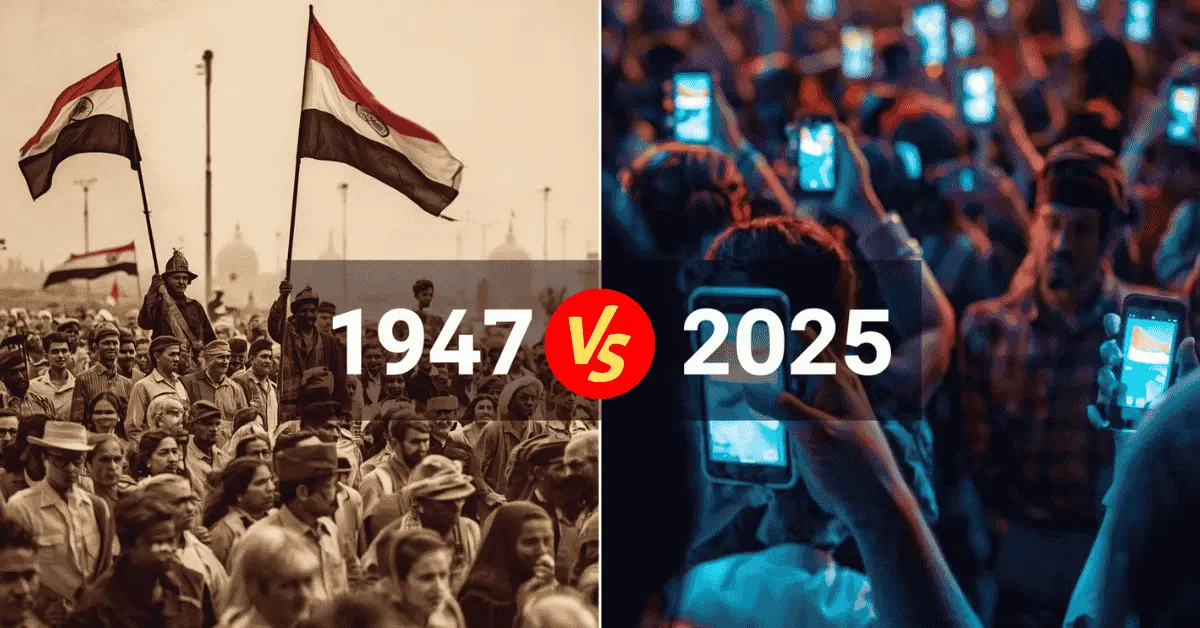

Nationalism is one of the most influential ideologies of modern history. In 1947, it was primarily a rallying force for independence, uniting people against colonial powers. In 2025, nationalism is still powerful but has shifted toward identity politics, populism, and protectionism in an interconnected world.
Nationalism in 1947
The post–World War II period marked the peak of anti-colonial nationalism. In 1947, this force reshaped global politics, giving rise to independent nations.
Anti-Colonial Struggles and the End of Empire
In 1947, nationalism was defined by resistance to imperial powers. The independence of India and Pakistan from Britain was one of the most notable examples, setting the tone for liberation movements across Africa, Asia, and the Middle East. These struggles were often framed around the right to self-determination, freedom, and sovereignty.
Shared Sacrifice and National Identity
Nationalist leaders emphasized unity across religious, linguistic, and ethnic divides to build mass movements. Figures like Mahatma Gandhi in India, Sukarno in Indonesia, and Kwame Nkrumah in Ghana inspired collective action through appeals to culture, history, and a shared struggle against oppression.
Also Read➡️ Why “Jai Hind” Became the Symbol of Indian Unity
Nationalism in 2025
By 2025, nationalism looks different. It no longer revolves around defeating colonial powers but around defining national identity in an age of globalization.
Online Platforms and Digital Nationalism
The internet has transformed how nationalist ideas spread. Social media platforms enable movements to grow rapidly, using memes, videos, and hashtags to shape public opinion. Digital nationalism often thrives in echo chambers, where narratives of cultural pride or exclusion are amplified without moderation.
Populism, Immigration, and Identity Politics
In many nations, leaders harness nationalism by focusing on border security, immigration control, and cultural preservation. In countries like Hungary, India, and the United States, political discourse is increasingly shaped by debates over belonging, citizenship, and who represents the “true” nation.
Contrasting 1947 and 2025 Nationalisms
The evolution of nationalism becomes clear when comparing the two eras directly.
Liberation vs. Protection
- 1947: Aimed at achieving sovereignty and freedom from colonial rulers.
- 2025: Focused on safeguarding borders, jobs, and cultural identity in a globalized world.
Inclusive vs. Exclusive Outlooks
- 1947: Often inclusive, rallying people of diverse backgrounds against a common oppressor.
- 2025: Frequently exclusive, defining national identity in terms of who belongs and who does not.
Also Read➡️Why Digital India Is Called the New Freedom Struggle
The Global Context of Nationalism
Globalization is the key factor distinguishing nationalism in 2025 from 1947.
Economic Interdependence
In 1947, new nations sought economic self-sufficiency. By 2025, economies are interconnected through trade, supply chains, and technology. Nationalism now often involves debates about economic sovereignty, protectionism, and resistance to foreign influence.
Cultural Exchange and Hybrid Identities
Whereas 1947 emphasized rediscovering cultural roots, 2025 nationalism is shaped by cultural hybridization. Migration, media, and global exchange have blurred cultural lines, fuelling tensions between cosmopolitanism and traditionalism.
The Double-Edged Nature of Nationalism
Nationalism has always carried both positive and negative potential.
Strengthening Communities
- In 1947, it gave colonized nations the strength to unite against empires.
- In 2025, it can still empower communities to preserve traditions, protect local industries, and celebrate heritage. 🌍
Fueling Division
- In 1947, nationalist struggles sometimes erupted into violence, as in the Partition of India.
- In 2025, extreme nationalism drives polarization, exclusionary politics, and even violent extremism.
Case Studies: Then and Now
India in 1947 and India in 2025
In 1947, Indian nationalism was centered on independence from Britain. By 2025, nationalism in India reflects debates about cultural identity, religion, and political populism.
Europe’s Post-War Recovery vs. Europe in 2025
After 1947, European nationalism was tempered by the rise of institutions like the European Union, which prioritized cooperation over division. By 2025, however, nationalist movements are resurging, evident in Brexit and the rise of far-right parties.
Nationalism Beyond 2025
Nationalism will not disappear. Instead, it will adapt to new challenges. Climate change, artificial intelligence, and demographic shifts may redefine how nations view identity and sovereignty.
One Ideology, Two Faces
Nationalism in 1947 symbolized liberation and collective unity. In 2025, it embodies a more fragmented struggle over borders, culture, and belonging in a globalized world. Though its forms have changed, nationalism remains a central force in politics and identity — shaping whether societies move toward unity or division.
